Fire stopping in King's Cross
Brand new buildings and old railway warehouses, side by side.
- Every seal labelled and photographed
- BM TRADA / FIRAS-certificated contractors
- Written price before any work
North of the stations, the old railway lands have been rebuilt over the last fifteen years or so. New office buildings and blocks of flats stand beside Victorian railway and industrial buildings that have been converted, such as the Granary Building and Coal Drops Yard. To the east and south there are older estates and mansion blocks.
New buildings
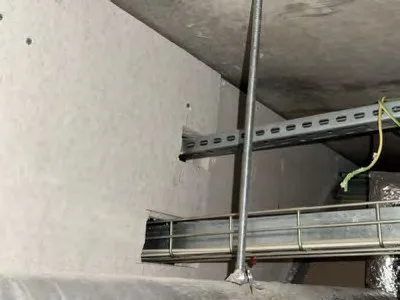
A new office building is handed over with fire stopping done and, usually, a schedule of seals in the handover manuals. Then tenants fit out their floors. Every fit-out adds data, power, air conditioning and plumbing through the core walls, and the risk is that the original seals are cut back and the new services never sealed.
The same applies in new blocks of flats, where broadband installers and kitchen and bathroom changes add new penetrations.
So in newer buildings we usually start by checking the risers and corridor voids against the original schedule, and list what has changed.
Converted Victorian buildings
When an old brick warehouse becomes offices, shops or flats, new fire walls and floors are built inside an old shell. The gaps are at the junctions: new partitions meeting old brick, new floors meeting cast iron columns, services running through both. These need joint seals as well as penetration seals.
Older estates
The older blocks round Somers Town and towards Caledonian Road have the familiar estate issues: replaced stacks, new heating pipes and cables through landing walls.
The sealing is carried out by our BM TRADA / FIRAS-certificated contractors.
Send the postcode, what the building is and a photo of the gap. We will tell you what it needs and give you a rough price.